
Why Auto Repair Shop Marketing Feels Unreliable
Most independent shop owners are not against marketing. They are against spending money on something they cannot explain.
Some weeks are packed. Others are slow for no obvious reason. Ads run, a website exists, reviews come in, and yet the results feel random. When things slow down, it is never clear whether the problem is marketing, seasonality, the front counter, or something else.
That uncertainty is the real issue.
Most shop owners are not against marketing. They are against guessing. When margins are tight and the shop already demands attention in ten different places, it is exhausting to invest in something that does not clearly translate into control.
Marketing feels unreliable not because demand is absent, but because most shops have no visibility into where work comes from, where it gets lost, and what is actually driving results week to week.

The Demand Problem Is Not What You Think
One of the most misunderstood aspects of auto repair shop marketing is demand.
In most local markets, vehicle owners are actively searching for repair services every day. Vehicles age. Maintenance gets deferred. Warning lights appear. The problem is rarely a lack of demand.
The problem is that demand arrives unevenly, and without structure to capture it consistently, shops end up reactive. Busy stretches feel accidental. Slow periods feel unexplainable. Neither is fully true, but without data it is impossible to tell the difference.
Much of this unevenness is structural, not seasonal. Calls go unanswered during busy hours. Form submissions sit in inboxes. Declined services are never followed up. These are not dramatic failures. They are small, repeatable leaks that collectively make marketing feel like it does not work.

Generic Marketing Advice Does Not Apply to Repair Shops
Most marketing advice was not written with auto repair shops in mind.
Most marketing content was built around businesses with long sales cycles, considered purchases, and customers who are comfortable doing research before deciding.
Auto repair customers are different. They are local. They are time-sensitive. They are often anxious about cost and trust. They are not browsing options over several days. They need a shop today, and the first one that earns their confidence is likely to get the job.
Advice about brand awareness, reach, and impressions does not translate well into decisions about staffing, hours, or whether to run a promotion next month. What matters to a shop owner is whether marketing reliably turns into booked appointments and approved repair orders.
When marketing advice ignores that reality, it becomes noise.
More Leads Is Not the Goal
A common assumption is that marketing success means generating more inquiries.
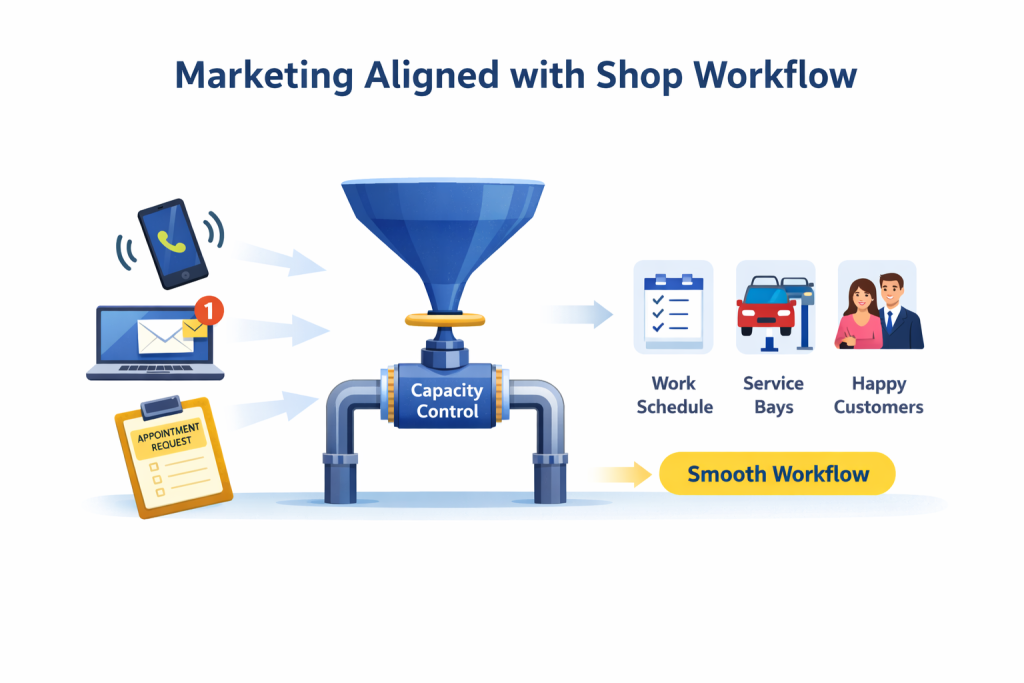
In practice, volume without process creates stress, not growth. Phones ring while the counter is already overwhelmed. Emails pile up. Follow-ups get skipped. The shop feels busier but not more profitable, and the team burns out faster.
What shops actually need is consistent flow: the right volume of work arriving predictably, for services the shop is equipped to handle, managed with enough structure that nothing falls through the cracks.
Marketing should support that flow. When it does not, even high-performing campaigns quietly fail.
The Shift That Makes Marketing Manageable
The shops that grow steadily tend to think about marketing differently.
They do not treat it as promotion that runs separately from operations. They treat it as part of how the shop manages demand: how work enters the pipeline, how it is handled, and how it converts into revenue.
The questions that follow from that shift are more useful. Instead of asking which platform to try next, they ask where their best customers come from and how to get more of them. Instead of wondering why a slow week happened, they look for where inquiries are consistently being lost.
That kind of thinking turns marketing from a cost into a tool.
The Metrics That Restore Confidence
Confidence in marketing does not come from a dashboard full of engagement numbers.
It comes from a small set of metrics that connect marketing activity directly to shop outcomes: repair orders by source, average ticket value by source, response time to new inquiries, and return visit rates.
When those relationships are visible, decisions become straightforward. Spending more on a channel that drives high-value repair orders is easy to justify. Cutting a channel that drives volume without profitability is equally easy to defend.
Most shops do not have this visibility yet. Building it does not require sophisticated tools. It requires consistency in how data is captured and reviewed.
What Control Actually Looks Like
When marketing is working, it gives a shop owner a specific kind of control.
Control over how busy the shop is. Control over the mix of work coming in. Control over whether to take on a new technician or adjust hours next month based on what the pipeline actually shows.
That level of control does not come from advertising more aggressively. It comes from connecting marketing to operations so that both sides inform each other.
That is the difference between shops that grow intentionally and shops that stay reactive.
Learn how RO Writer Connect helps shops connect marketing activity to real repair order outcomes.